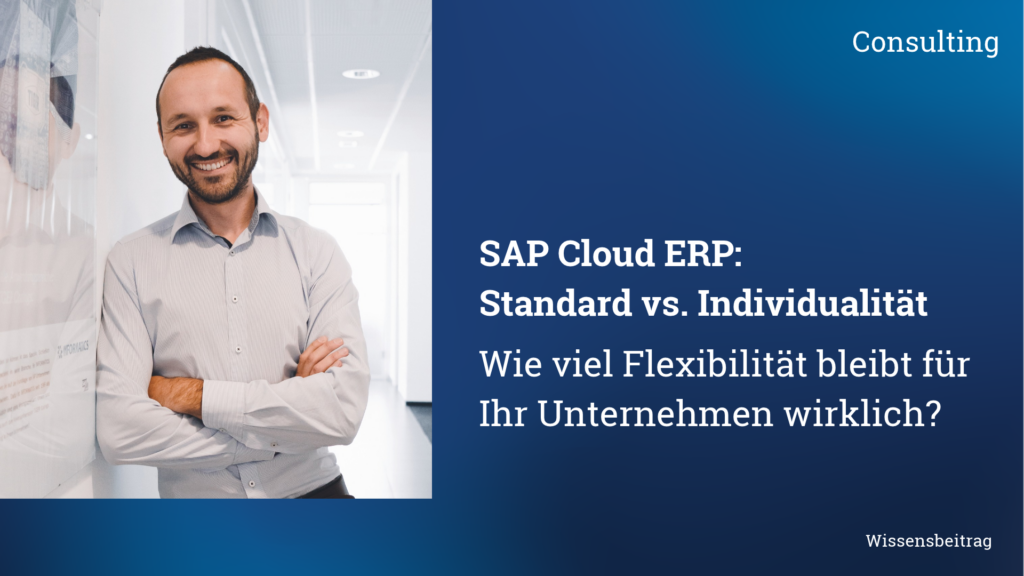

SAP Cloud ERP (formerly SAP Public Cloud) combines proven best practices with standardized end-to-end processes, high scalability, and continuous innovation. Companies benefit from an integrated platform that enables rapid decision-making and flexible growth, as well as stable, future-proof operations.
Why do companies choose SAP Cloud ERP?
Strategic factors such as scalability, future-proofing, and a predictable operating model are particularly crucial. Licensing, operation, maintenance, and updates are included. New features are automatically rolled out at least twice a year, eliminating the need for upgrade projects. Best-practice processes based on over 50 years of SAP experience promote efficiency, automation, and high user acceptance.
How do companies benefit from standardized processes?
As a Software as a Service (SaaS) solution, SAP Cloud ERP offers transparency and planning reliability. Resources can be scaled flexibly; the device-independent Fiori interface supports productive work and high user acceptance, while best practices ensure proven processes. Licensing, operation, maintenance, and updates are included in the subscription. Real-time information, analytics, and AI-based insights enable informed decisions, while security and compliance standards are professionally maintained.
Can custom extensions be implemented?
A persistent misconception is that SAP Cloud ERP does not allow for customization. In fact, SAP consistently follows the “clean core” approach: The standard core remains stable, while individual requirements can be specifically addressed. Key-user extensions enable simple customizations, such as additional fields or validation rules. More complex scenarios can be implemented using side-by-side extensions on the SAP Business Technology Platform (BTP), which integrate seamlessly into SAP processes. Customer-specific ABAP developments are also possible—but only at defined extension points such as Business Add-Ins (BAdIs) or CDS views.
How can extensions remain upgrade-safe?
Extension points follow clear rules. Transactional contracts define how extensions interact with business processes, create transparency, and ensure upgradeability. What used to mean unlimited freedom is now deliberately controlled in favor of stability and long-term maintainability.
What advantages does SAP Cloud ERP offer when it comes to debugging?
SAP Cloud ERP also sets the standard for debugging: Developers can analyze errors in a traceable manner across development, test, and quality systems. Runtime manipulations and change debugging are a thing of the past. Structured testing, clean development, and clear analysis processes significantly improve the quality of solutions.
Is SAP Cloud ERP a compromise?
SAP Cloud ERP is not a compromise, but a conscious decision to standardize while allowing for flexibility. Companies that harmonize processes and actively shape change management create a stable, integrated platform. This lays the foundation for sustainable innovation, lower operating costs, and a technologically future-proof ERP landscape.
Related posts